
How to Measure a Cocktail
A cocktail is a ratio, and a ratio you cannot repeat is not a recipe. Measuring is the least glamorous habit in mixing and the one that improves a home bar fastest: it turns a drink that was good once into a drink that is good every time, and it makes a bad drink diagnosable instead of mysterious.
The short answer
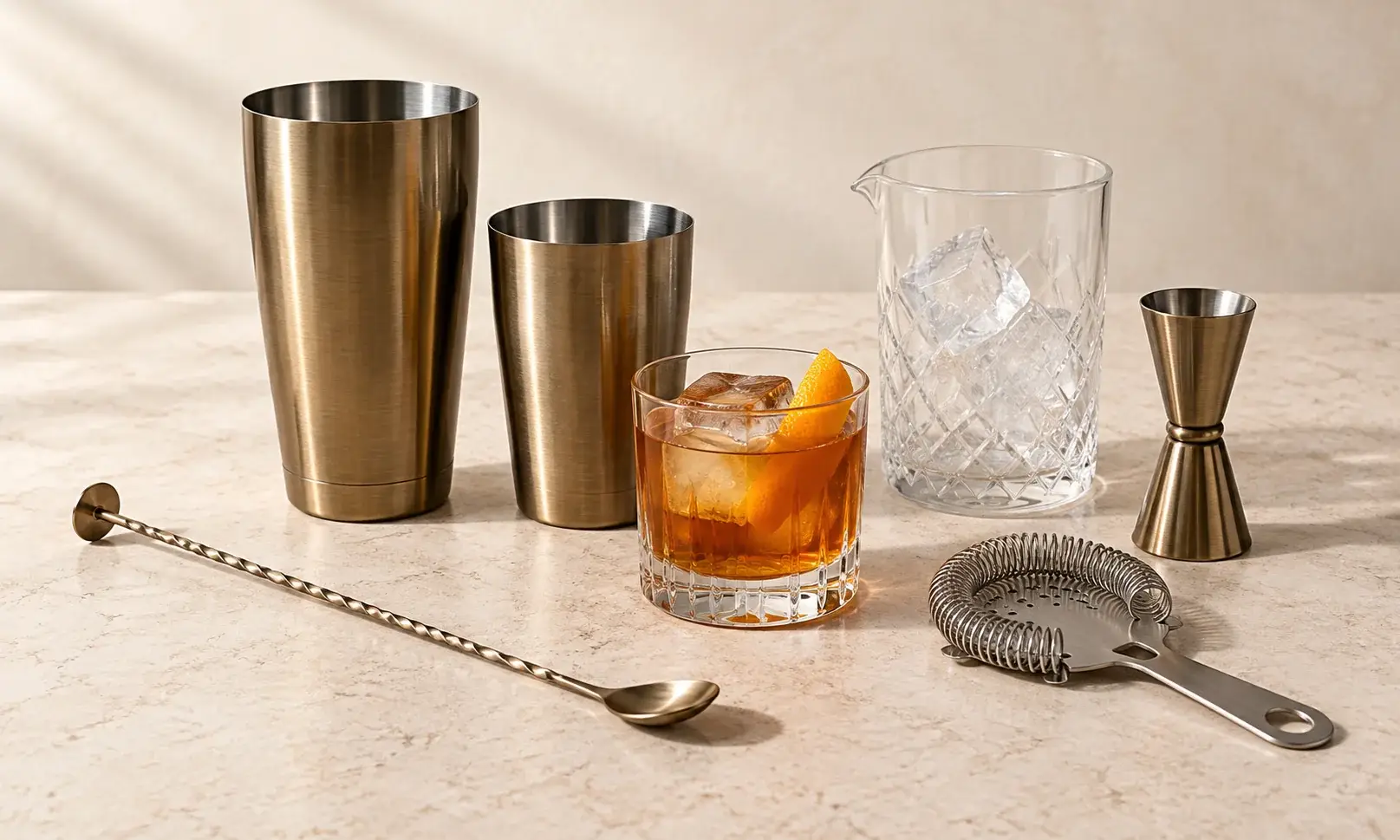
Buy one Japanese-style jigger, 2 oz on one side and 1 oz on the other, with interior lines at 1.5, 0.75, 0.5 and 0.25. Fill it to the line, not to the brim. Treat 1 oz as 30 ml, a barspoon as 1 teaspoon, and a dash as about 1 ml, which is one firm shake of an Angostura bottle.
Why free pouring does not work at home
Bartenders who free pour are counting against a calibrated speed pourer, on bottles they use hundreds of times a week, for a small set of drinks. Even then the good ones check themselves against a jigger.
At home none of that holds: your bottles have different necks, most have no pourer, and you are making a drink you last made a month ago. The error is not small. A quarter-ounce overpour of syrup in a Daiquiri is a third more sugar than the recipe asked for, and it is the difference between bright and cloying. Half an ounce more gin in a Martini changes the ratio from 5:1 to 7:1, which is a different drink with the same name.
The units, demystified
Ounce. A US fluid ounce is 29.57 ml. Every bar on earth rounds it to 30 ml, and so do the recipes here; the error is a fifth of a millilitre and nothing in a cocktail is that sensitive.
Part. A proportion, not a volume. “Three parts gin to one part vermouth” means you pick the size of the part. Useful for punches and for scaling: see batching.
Barspoon. About 5 ml, the same as a teaspoon, or a sixth of an ounce. Recipes use it for things where precision is less important than restraint: a barspoon of maraschino, of crème de menthe, of rich syrup.
Dash. One firm shake from a dasher-topped bitters bottle, roughly 0.8 to 1 ml, about a thirty-second of an ounce. It is not a precise unit and does not need to be, but be consistent: hold the bottle vertically and snap your wrist once. Six drops from a dropper is a fair equivalent.
Teaspoon and tablespoon. A teaspoon is a sixth of an ounce; a tablespoon is half an ounce. Both appear in older recipes and in the Caipirinha family, where sugar is measured dry.
Pinch. What you can hold between thumb and two fingers, about an eighth of a teaspoon. Used for salt and celery salt.
Which jigger to buy
A tall, narrow, Japanese-style jigger with interior graduation lines is the one worth owning: 2 oz and 1 oz cones, lined at 1.5, 0.75, 0.5 and 0.25. Narrow cones are more accurate than wide ones because a millimetre of depth is less volume.
Fill to the line and look at it from the side, not from above. A jigger filled to the brim holds noticeably more than its stated volume, which is how people end up with consistently strong, unbalanced drinks and conclude that the recipe is wrong.
If your jigger has no lines, buy a second small one (0.75 and 0.5 oz) rather than guessing halves. Avoid the cheap double-cone jiggers with no lip: they spill, and they are usually a few millilitres out.
When to use a scale instead
For batching, weight beats volume. A kitchen scale accurate to a gram is faster than measuring thirty jiggers, loses nothing to the sides of the vessel, and makes the arithmetic trivial: water and most spirits are close enough to 1 g per ml for bar purposes, and syrups are denser, which a scale accounts for automatically and a jigger does not.
Weighing is also the honest way to make a syrup: two parts sugar to one part water by weight is a rich syrup every time, where “two cups to one cup” depends on how you packed the cup.
Questions
How many ml is an ounce? 29.57, rounded to 30 everywhere in practice.
How much is a dash? About 1 ml, one firm shake of a dasher bottle. Six dropper drops is close.
Is a barspoon the same as a teaspoon? Close enough, around 5 ml. Japanese barspoons run a little smaller.
What if a recipe says parts? Choose your own part size and keep it constant: a part can be half an ounce for one drink or a cup for a punch bowl.
Do I really need to measure bitters? Count the dashes, yes. Two dashes and five dashes are different drinks.
Small details. Better drinks.
Your next great drink
could already be on your shelf.
Choose your bottles and mixers. Find your next pour.