
Jigger
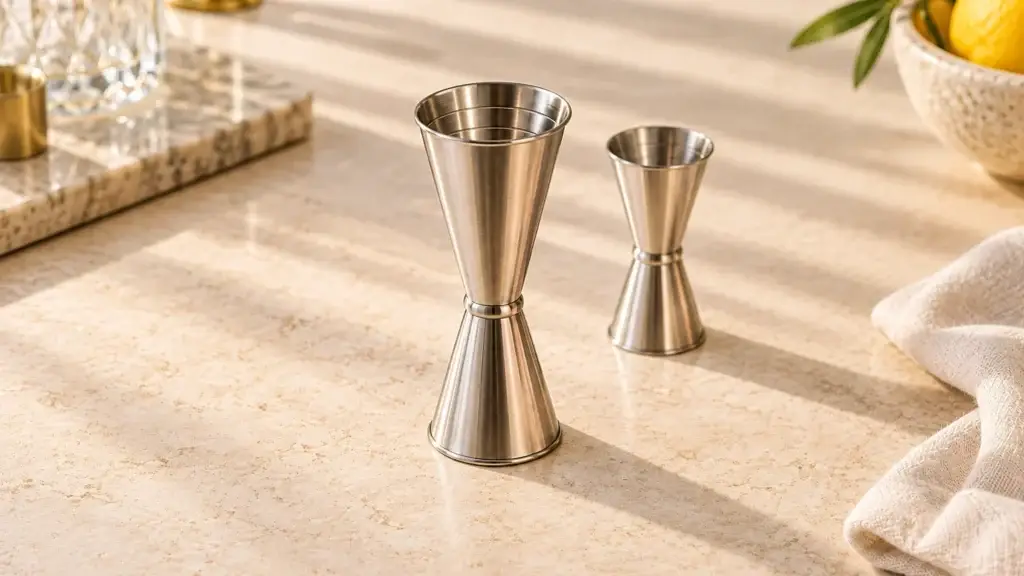 AI sample photography
Nothing else you buy improves a drink if the ratio is wrong. A jigger is the first purchase for a home bar and the one that changes the most, because almost every bad homemade cocktail is a correct recipe poured in the wrong proportions.
Our picks
Buy a Japanese-style jigger: tall, narrow, sharply waisted, with interior graduation lines. The height is the point — a narrow vessel makes a given volume a taller column of liquid, so a small error in the meniscus is a small error in the pour. A wide, shallow bell jigger turns the same misjudgement into a quarter-ounce.
The useful pair is a 2oz / 1oz jigger with interior lines at ¾, ½ and ¼, plus a smaller 1oz / ½oz for bitters-adjacent amounts and splits. Stainless steel, one piece, no seams inside. If you only ever buy one, make it the 2oz/1oz with internal markings.
Metric kits exist in 50/25ml with 15ml and 10ml lines and are equally good — just do not own both systems and mix them mid-drink.
How to choose
Check four things. Interior graduations, stamped or etched inside the cone rather than printed outside, which is what lets one jigger do five measurements. A sharp rim, so the pour breaks cleanly instead of running down the outside. Weight and balance, since a jigger that tips when you set it down half full is a nuisance. Seamless interior, because a welded seam traps residue and is tedious to clean.
Verify the volume rather than trusting the stamp. Measure water into the jigger and weigh it: one fluid ounce of water is about 29.6 grams, 25ml is 25 grams. Cheap jiggers are routinely out by several per cent, and a jigger that lies consistently is worse than no jigger, because you will be calibrating your palate against it.
How to use it
Hold it between index and middle finger with your thumb on the waist, which leaves the hand steady and lets you tip it without regripping. Fill to the brim of the cone or exactly to the line — not nearly, not a confident splash over. Surface tension will let you fill a jigger slightly proud of the rim, and that is already a measurable error.
Pour over the tin, not over the worktop, so the inevitable overshoot lands in the drink rather than beside it. Measure the cheapest ingredient first where you can, so a mistake costs syrup rather than spirit.
Work in one system for the whole drink. The common disasters come from treating 25ml and 1oz as the same thing across a four-ingredient spec; they are about 18 per cent apart and the error compounds. There is more on this in how to measure a cocktail.
Rinse it between dissimilar ingredients and particularly between anything sticky and a spirit. A jigger with syrup in the bottom quietly sweetens the next measure.
What to skip
Skip the shallow bell jigger that comes in gift sets — wide, unmarked, and usually 1½oz and ¾oz, which are not the amounts most recipes call for. Skip plastic jiggers, which stain and warp. Skip speed pourers and free-pouring counts as a substitute; counting is a professional skill built on thousands of repetitions with one specific pourer, and it does not transfer to your bottles.
Skip anything that only has exterior printing, which wears off in the dishwasher within months. And skip the idea that a shot glass will do: most are not accurate, many are not marked, and a “shot” is not a fixed volume anywhere.
Questions
What size jigger should I buy first? A 2oz / 1oz Japanese-style jigger with interior lines at ¾, ½ and ¼.
Is a jigger really necessary? It is the single tool that most improves a drink. Ratios are what make cocktails work.
Ounces or millilitres? Either, consistently. Mixing the two mid-recipe is the actual problem.
How do I check mine is accurate? Weigh water in it. One fluid ounce is about 29.6 grams.
Can I use measuring spoons? For small amounts, yes. A tablespoon is half an ounce and that is a genuinely useful fact.
Read the full bar tools guide — which seven tools to buy, in what order, and what to ignore.