
Hawthorne Strainer
 AI sample photography
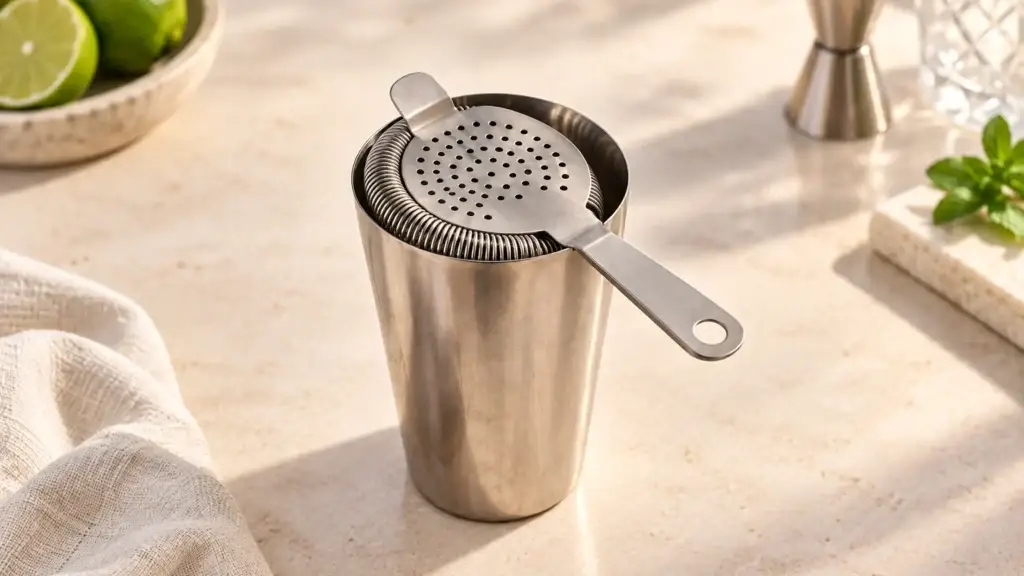
The Hawthorne is the strainer with the coiled spring, and the spring is not decoration. It sits inside the rim of the tin, holds back the ice and whatever is left of the fruit, and — if it is a good one — filters finely enough that many drinks need nothing more.
Our picks
Buy a stainless Hawthorne with a dense, tight spring and a gate you can push with your index finger. Spring tightness is the single quality marker: a tight coil with many turns catches small ice shards and herb fragments, while a loose, widely spaced spring lets through exactly the debris you were trying to stop.
Look for a strainer with four prongs rather than two, which keeps it seated in the tin without wandering, and a flat, broad finger rest on the gate. One strainer is enough; this is not a tool you need duplicates of.
A fine-spring Hawthorne removes the need to double strain for many drinks, which is a real time saving and the reason the better ones are worth the small premium.
How to choose
Press the spring with a thumbnail — it should feel dense and resist, not splay. Count the gaps: visible daylight between coils means ice chips will follow the drink into the glass.
Check that the spring is removable, because it needs cleaning and it will eventually need replacing. Springs are the part that fails; a strainer with a replaceable spring lasts indefinitely.
Check it fits your tins. A Hawthorne that is slightly too small rocks in the rim and lets a channel open at the side; one that is too large will not seat. If you are buying tins and strainer together, buy them from the same supplier.
How to use it
Seat it in the large tin with the spring facing the ice and your index finger on the gate. The gate slides, and sliding it changes the gap at the front of the strainer: pushed forward, the gap closes and the flow is slow and finely filtered; pulled back, it opens and pours faster. Most of the time you want it forward.
Pour in one continuous motion, holding the tin and strainer together in one hand. Stop before the last of the liquid, which carries the most sediment.
For anything shaken with fruit, herbs, egg white or crushed ice, hold a fine mesh strainer under it and double strain — the Hawthorne holds back the ice, the mesh catches everything else.
For a stirred drink in a mixing glass, a julep strainer is traditional, but a Hawthorne works in a mixing glass perfectly well and saves owning a third strainer.
What to skip
Skip loose-spring strainers, which are the default in cheap kits and the reason people think they need to double strain everything. Skip strainers with a fixed, non-removable spring, since you cannot clean behind it properly and cannot replace it when it goes.
Skip the julep strainer as a first purchase — it is a perforated bowl for stirred drinks, it is lovely, and a Hawthorne does its job. Skip strainers built into shakers, which are universally too coarse.
Skip the two-prong designs that come with gift sets; they slide around in the tin and let the drink escape at the edge.
Questions
What does the gate do? It slides to widen or narrow the gap at the front, controlling flow and how finely the drink is filtered.
Do I still need to double strain? With a tight-spring Hawthorne, far less often. Always for egg, herbs, muddled fruit and crushed ice.
Hawthorne or julep strainer? Hawthorne first. It handles shaken and stirred; the julep only suits stirred.
Why do ice chips get through? A loose spring. Count the gaps between the coils before you buy.
Can I put it in the dishwasher? Yes, with the spring removed, or residue collects inside the coil.
Read the full bar tools guide — which seven tools to buy, in what order, and what to ignore.