
Muddler
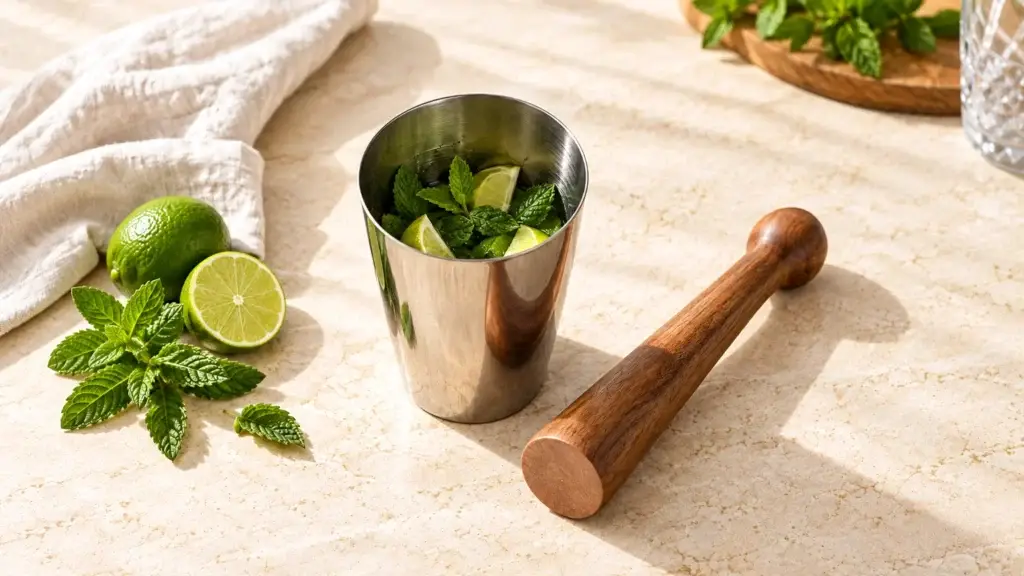 AI sample photography
Most muddlers sold in kits have teeth on the end, and the teeth are the problem. They shred mint into bitter green confetti and crack the pips in citrus and berries. A flat, smooth face presses — which is what muddling is supposed to be — and the difference in the finished drink is not subtle.
Our picks
Buy a flat-faced muddler, 20 to 25cm long, in untreated hardwood or one-piece stainless. The face should be smooth and broad enough to cover most of the bottom of a tin. Length matters because you want your hand clear of the glass rim with room to press straight down.
Hardwood has the better feel and is gentler on glass. Stainless is easier to sterilise and will never split. Both are correct; the thing to avoid is a toothed or ridged head, whatever it is made of.
If you buy wood, buy it unvarnished and unpainted. Coatings chip into the drink, which is both unpleasant and the reason cheap painted muddlers have a short life.
How to choose
Feel the face. Smooth and flat, or very slightly domed. If you can see teeth, put it down.
Check the construction. A one-piece tool — carved wood, or solid stainless — has nothing to come apart. Muddlers with a plastic or nylon head glued onto a metal shaft are the common failure: the glue goes, usually mid-drink.
Check the diameter against your vessel. A head much narrower than the base of your tin means you are chasing mint around rather than pressing it, and one too wide will not reach into a glass.
Check the finish for roughness if it is wood. A rough face holds residue and shreds leaves on contact.
How to use it
For herbs, the instruction is press and twist gently, two or three times, and stop. You are bruising the leaves to release oil, not pulping them. Mint muddled hard turns bitter and black, and that bitterness comes from the leaf tissue you have destroyed. In a Mojito, a press firm enough to smell the mint is firm enough.
For citrus wedges, press harder — you are extracting juice and a little oil from the peel. A Caipirinha wants the lime properly crushed, though still not pulverised, since the white pith will give up bitterness if you keep going.
For sugar cubes, as in an Old Fashioned, muddle the cube with the bitters and a splash of water until it is a wet paste before any spirit goes in. Sugar will not dissolve in cold alcohol, which is why the order matters.
For berries and stone fruit, press gently and double strain afterwards. See also muddled drinks generally.
Wash it immediately, especially wood, and never leave it soaking. Dry it standing up.
What to skip
Skip toothed muddlers — they are the single most common bad bar tool, and they are in nearly every gift set. Skip painted or varnished wood, which chips.
Skip the muddler end on a barspoon, which is too small and too awkward to press with properly.
Skip dishwashers for wooden muddlers; the heat and the soak split them. And skip muddling in a thin glass — press down hard in a delicate highball and it will eventually crack. Muddle in a tin or a sturdy rocks glass.
Questions
Why is my mojito bitter? You muddled the mint too hard. Press and twist gently, two or three times.
Wood or stainless? Either. Avoid teeth, coatings and glued-on heads.
How long should it be? 20 to 25cm, so your hand clears the rim.
Can I use a rolling pin or spoon? At a push. A wooden spoon handle works; anything thin risks cracking the glass.
Do I muddle before or after the ice? Always before. Muddling against ice shreds the herbs.
Read the full bar tools guide — which seven tools to buy, in what order, and what to ignore.