
Ice and Dilution
Ice is the ingredient nobody measures and everybody drinks. In a shaken cocktail, roughly a quarter of what reaches the glass is melted ice; in a stirred one, a fifth. Change the ice and you change the recipe, which is why the same specification can produce a balanced drink in one bar and a watery one in another.
The short answer
Use the biggest, hardest, driest ice you can, fill the tin or mixing glass completely, and never mix with ice you have already used. Big cubes for stirring and for serving, standard cubes for shaking, crushed for juleps, swizzles and tiki. Target about 20 per cent dilution stirred and 25 per cent shaken, judged by frost on the glass rather than by a clock.
Why dilution is not a compromise
Water does three useful things in a cocktail. It lowers the alcohol by volume to something drinkable, so a drink built from 40 per cent spirits arrives at 20 to 25 per cent. It carries aroma: many aromatic compounds are more volatile in a weaker solution, which is why a Scotch opens up with a few drops of water and why an undiluted Martini smells closed. And it softens the burn, letting you taste the vermouth and the bitters rather than the ethanol.
A good cocktail is diluted on purpose, to the right degree. Too little and the drink is tight, hot and short. Too much and it is flabby: the flavours are all still there but nothing has any edge. Neither fault is about the recipe, and no change of brand will fix either one.
Cold is a flavour control
Temperature changes what you taste. Cold suppresses the perception of sweetness, so a drink that tastes balanced at minus two degrees tastes syrupy at ten. It also suppresses the burn of alcohol and lifts the impression of acidity. That is why a Daiquiri must arrive genuinely cold, and why the same drink is unpleasant by the third sip once it has warmed in a thin, room-temperature glass.
The practical consequence: chill the glass as seriously as you chill the drink. A frozen coupe keeps a drink in its window for several minutes; a warm one costs you two or three degrees on contact.
Which ice for which drink
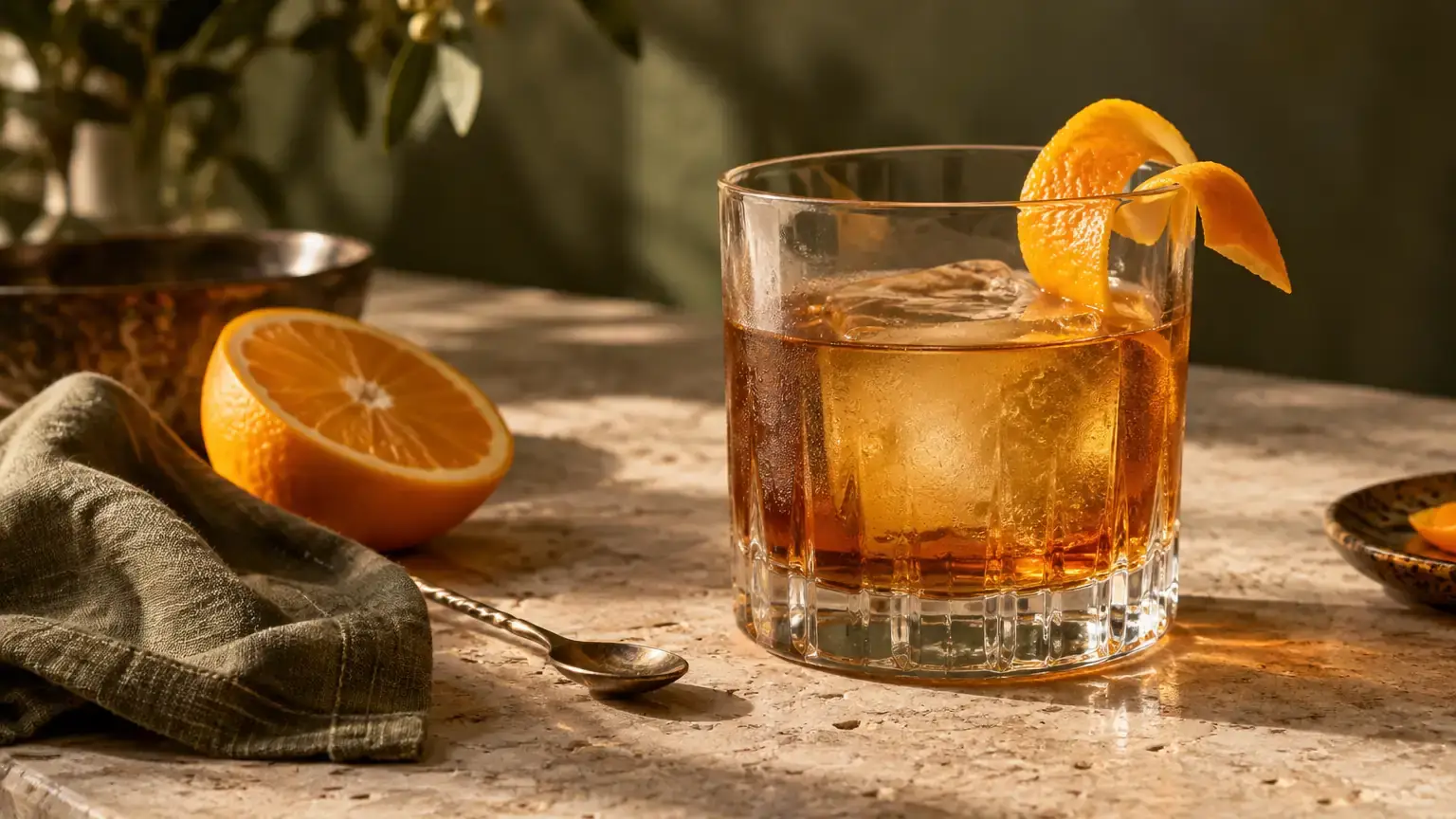
Large cubes, two inches or more. For stirring, and for serving a drink on one rock: an Old Fashioned, a Negroni, a whisky. Minimum surface area, slowest melt, so the last sip resembles the first.
Standard cubes, around one inch. For shaking and for highballs. Fill the tin; fill the highball glass to the top, because a glass half-full of ice melts faster than a glass packed with it.
Crushed or pebble ice. For a Mint Julep, a Queen’s Park Swizzle and most tiki. It dilutes fast and deliberately: these drinks are built strong to be watered down as you drink them, and the frost on the outside of the cup is part of the experience. Make it in a Lewis bag with a mallet, which also dries the ice as it crushes.
No ice. Anything served up, after straining, and hot drinks.
Clear ice at home
Cloudy ice is not dirty; it is full of trapped air and tiny cracks, which is why it melts quickly and splinters. Clear ice forms when water freezes slowly in one direction, pushing air and impurities ahead of the ice front.
The simple home method: fill a small insulated cooler with water, leave the lid off, and put it in the freezer for 18 to 24 hours. The top two-thirds freeze clear from the surface down; the cloudy last third stays at the bottom. Lift the slab out, let it temper for ten minutes so it stops cracking, and cut it with a serrated knife into cubes. One cooler gives you a week of serving ice.
Keep it in a sealed bag or box, because ice absorbs freezer smells readily, and a cube that tastes of last week’s fish will ruin a Martini all by itself.
Common dilution faults
Wet ice. Ice straight from a bag that has been opened and refrozen is glazed with water that goes into the drink before you start. Drain it or use fresh.
Half-filling the tin. Fewer cubes means more tumbling room, faster melting and worse control. More ice dilutes less, which is the opposite of most people’s instinct.
Reusing shaking ice. It is broken, wet and already halfway melted. Shake with one batch, serve over another.
Judging by the clock alone. Ice temperature and size vary. Frost on the tin and pain in your hand are better instruments than a count.
Questions
How much water ends up in a shaken cocktail? About a quarter of the finished volume; a fifth in a stirred one.
Does ice straight from the freezer melt less? Yes. Ice at minus eighteen has to warm before it melts, so it dilutes less than ice that has been sitting on the bar.
Is clear ice worth the trouble? For a drink served on one big cube, yes: it melts slower and looks better. For shaking, nobody can tell.
Can I pre-dilute and skip the ice? For a batch, yes, and that is exactly how batching works: add the water in advance and chill it hard.
Small details. Better drinks.
Your next great drink
could already be on your shelf.
Choose your bottles and mixers. Find your next pour.