
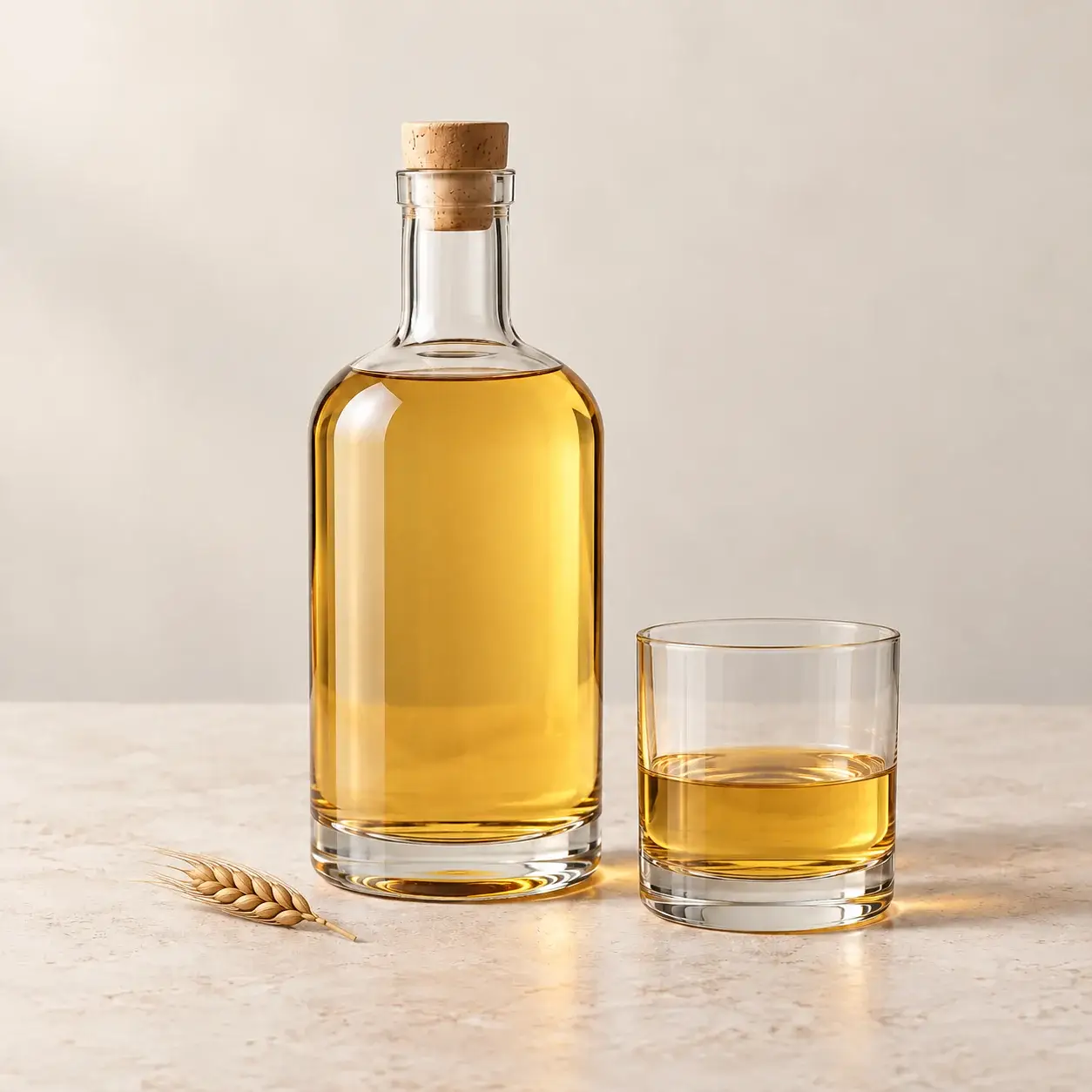
Scotch whisky is grain spirit made in Scotland and aged at least three years in oak. It has a reputation as the spirit you do not mix, which is a shame and not historically true — the Rob Roy, the Blood and Sand and the Penicillin are all excellent, and blended Scotch was a cocktail staple long before single malt became a collector's item.
What is Scotch whisky?
Scotch is one of the most tightly regulated spirits in the world. The Scotch Whisky Regulations require:
- Produced at a distillery in Scotland from water and malted barley, with other whole cereal grains permitted for grain whisky
- Processed at that distillery into a mash, fermented only by endogenous enzyme systems, with yeast and nothing else added
- Distilled to no more than 94.8% ABV
- Matured in Scotland in oak casks of no more than 700 litres for at least three years
- Bottled at no less than 40% ABV
- Nothing added but water and plain caramel colouring (E150a) — no flavouring, no sweetening
Any age statement on the bottle refers to the youngest whisky in it. The five legal categories are worth learning because the labels are precise:
| Category | Means |
|---|---|
| Single Malt Scotch | Malted barley only, pot stills, one distillery |
| Single Grain Scotch | Other grains permitted, one distillery |
| Blended Malt Scotch | Single malts from more than one distillery |
| Blended Grain Scotch | Single grains from more than one distillery |
| Blended Scotch Whisky | Malt plus grain whisky; most of the market |
How it's made
Malt the barley — steep it, let it germinate, then dry it in a kiln. If peat is burned in that kiln, phenolic smoke compounds bind to the grain, and that is the entire source of peatiness. No peat in the kiln, no smoke in the glass.
Mash, ferment, then distil twice in copper pot stills for malt whisky or continuously in column stills for grain whisky. Fill into oak — overwhelmingly ex-bourbon barrels, with ex-sherry butts used for richer styles and a growing use of port, wine and rum casks for finishing. Mature in Scotland's cool, damp climate, where the angel's share runs around 2% a year, so maturation is slow and long ageing is genuinely possible.
What it tastes like
The range is enormous, which is why "I don't like Scotch" usually means "I tried one Scotch". Broadly: cereal and honey from the barley, vanilla and coconut from ex-bourbon oak, dried fruit and spice from sherry casks, and — in the peated styles — smoke, iodine, tar, seaweed and medical antiseptic. Those last descriptors are compliments.
Scotch is drier than bourbon because the barrels are not new, so less wood sugar is extracted, and because sweetening is prohibited.
Regions worth knowing
The regions are legally defined for labelling but are geographic, not stylistic guarantees — there are unpeated Islay malts and smoky Highland ones. Still, as a starting map:
| Region | Typical character | In a drink |
|---|---|---|
| Speyside | Fruity, honeyed, often sherried | The easiest region to mix; great in a Rob Roy |
| Highland | Broad; heather, pepper, some coastal | Versatile all-rounder |
| Lowland | Light, grassy, floral | Good in long and citrus drinks |
| Islay | Peat, brine, iodine | A rinse or a quarter-ounce, not the base |
| Campbeltown | Oily, briny, faintly smoky | Excellent and distinctive in stirred drinks |
Which bottle to buy
For cocktails, buy a good blended Scotch — not a single malt. This is the piece of advice most often ignored and most often right. Blends were engineered to be smooth, consistent and affordable, which is exactly what a cocktail base needs, and a £25 blend makes a better Rob Roy than a £70 malt whose subtleties vanish under vermouth.
Then, separately, buy one small bottle of heavily peated Islay to use as a modifier. A quarter-ounce in a Penicillin, or a rinse in the glass, transforms a drink; it is one of the highest-impact bottles per pound in any cabinet, and it will last a long time because you use so little.
Prefer non-chill-filtered bottlings at 43% or above if you can find them — more texture, and they hold up better against ice.
Using it in drinks
Scotch mixes best with honey, lemon, ginger and sweet vermouth. The Penicillin — blended Scotch, honey-ginger syrup, lemon, with an Islay float — is the modern classic that settled the argument about whether Scotch belongs in a shaker. The Rob Roy is a Manhattan made with Scotch, and the Blood and Sand pairs it with cherry liqueur and orange juice.
With peat, treat it as a seasoning. A full two ounces of Islay malt in a sour will flatten everything else in the glass. A float, a rinse, or a quarter-ounce in a split base gives you the smoke without losing the drink.
A Highball of blended Scotch and good soda, built tall over hard ice, is also simply one of the best long drinks there is.
Substitutes
Irish whiskey is the gentlest swap — lighter and softer, with no peat, so a Rob Roy becomes rounder. Japanese whisky was built on the Scotch model and substitutes almost exactly, often at a higher price. Bourbon works but brings sweetness and new-oak vanilla, which changes honey-and-lemon drinks noticeably. Canadian whisky is close to a light blended Scotch in function. For peat specifically there is no substitute; mezcal gives smoke, but of a completely different kind.
Storage
Upright, cool, out of light — sunlight will fade the colour and dull the aroma of a bottle left on a windowsill. Scotch does not age in glass. Once opened, oxidation is slow but real: the last third of a bottle will soften over a year or two, and a heavily peated whisky loses smoke noticeably. If you are nursing something special, decant it to a smaller bottle to cut the air.
Questions
Is it wrong to put Scotch in a cocktail? No. Blended Scotch was a standard cocktail base for most of the twentieth century. The convention that Scotch must be drunk neat is relatively recent and mostly a function of single-malt marketing.
Why is it spelled whisky without an e? Scotland, Canada and Japan use whisky; Ireland and the United States generally use whiskey. It is a convention of origin, not a difference in the product.
Does a 12-year-old Scotch mean every drop is 12 years old? It means the youngest whisky in the blend is at least 12. Most bottles contain considerably older whisky as well.
Can I add water or ice? Yes, and a few drops of water genuinely opens up most cask-strength whiskies. The idea that this is a mistake is snobbery; distillers do it themselves when nosing samples.
Scotch Whisky cocktails.
5 recipes
Scotch Sour
Scotch Sour is made with blended Scotch, lemon, rich syrup, egg white and aromatic bitters, chilled for serving.
Whiskey Mac
A Whiskey Mac combines equal measures of Scotch whisky and ginger wine directly in a rocks glass for a short drink with…
Blood and Sand
Scotch, cherry liqueur, sweet vermouth and orange juice in equal parts. A strange-sounding drink that works, and the only classic built on…
Rob Roy
A Manhattan made with Scotch. Smokier, drier, and proof that Scotch belongs in a mixing glass.
Penicillin
Blended Scotch, honey, ginger and lemon under a float of Islay. The drink that settled the argument about whether Scotch belongs in…