
Large-Cube Ice Tray
 AI sample photography
A big ice cube is not an affectation. Dilution is driven by surface area, and a single two-inch cube has far less surface per unit of volume than the handful of small cubes it replaces — so it chills the drink and then melts slowly, instead of quietly turning a spirit-forward drink into water.
Our picks
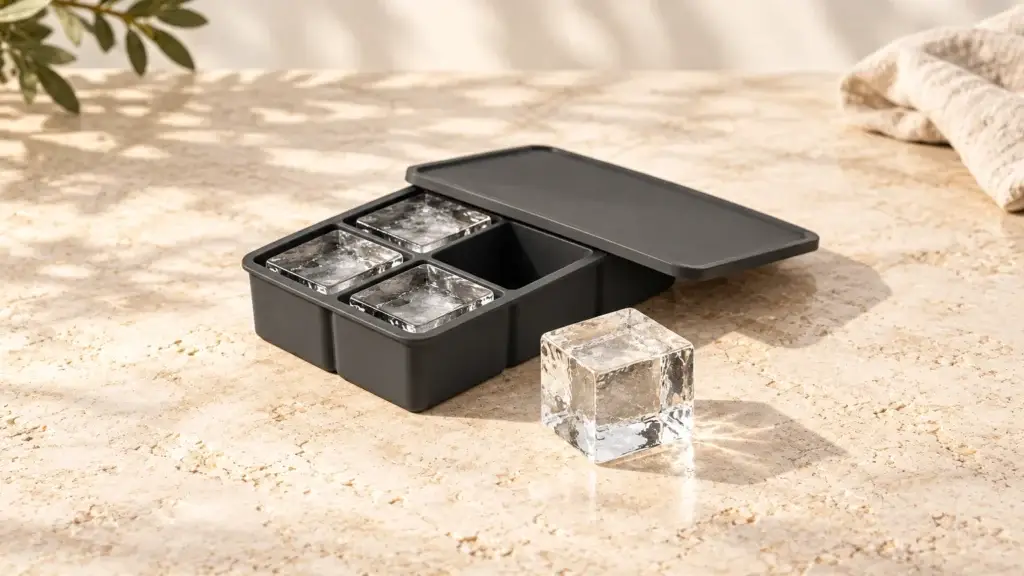
Buy a silicone tray with a hard lid that makes cubes around 5cm (two inches). The lid is the part people skip and regret: it keeps the cubes square, keeps freezer smells out, and lets you stack trays.
Six cavities is the practical size. Two trays is better than one large one, because you can fill one while the other is frozen.
A sphere mould makes a handsome ball with slightly less surface area than a cube of the same size. It is a marginal technical win and a noticeable aesthetic one. Cubes stack better in a freezer.
How to choose
Check the cavity size, which is the whole point — anything under about 4cm is just a slightly larger ordinary cube. Then check the cube against your glass: a 5cm cube needs a double rocks glass, and will jam in a standard rocks glass with no room for the drink.
Check the silicone quality. Thin, floppy silicone twists when you carry a full tray to the freezer and you will spill it. Thicker walls with a rigid frame or lid solve that.
Check that the lid seals rather than simply resting on top. Ice absorbs odours readily, and a freezer full of food will flavour an unlidded tray within days.
How to use it
Fill with filtered water — the ice is a quarter of what ends up in the glass, so chlorinated tap water tastes of chlorine in the drink. Fill slightly under the rim so the expansion has somewhere to go.
Freeze hard and long. A cube that is frozen through at a low setting is denser and melts more slowly than one pulled out early. Overnight at minimum.
To get clearer ice without any equipment, use boiled and cooled water, which drives off dissolved air, and freeze slowly. The genuinely clear ice seen in bars comes from directional freezing — an insulated container that freezes top-down and pushes the cloudiness into a base you cut off — which you can improvise with a small cooler box left open in the freezer. The cloud is trapped air and impurities and it affects looks, not taste.
Release the cube by twisting the tray and pushing from underneath, not by levering at it with a knife. Let it sit for thirty seconds if it resists; a cube straight from a deep freeze is brittle and will crack.
Use it in spirit-forward drinks — an Old Fashioned, a Negroni, a Boulevardier — where slow dilution is the point. See ice and dilution.
What to skip
Skip lidless trays, which give you odd-shaped cubes that taste of the freezer. Skip novelty shapes — skulls, diamonds — whose fiddly corners melt fast and defeat the purpose.
Skip the idea that big ice suits everything. A Mint Julep or a Mojito wants crushed ice precisely because it should dilute quickly and chill hard.
Skip expensive clear-ice machines unless you genuinely care; a cooler box in the freezer does the same job for nothing.
Questions
Why does big ice melt slower? Less surface area per unit of volume, so less contact with the drink.
What size cube should I make? About 5cm, and check it fits your glass — it usually needs a double rocks.
How do I get clear ice? Boiled, cooled water frozen slowly, or directional freezing in an open insulated box.
Does cloudy ice taste different? Not really. It is trapped air. Bad-tasting water is the real culprit.
Do I need a lid? Yes. Ice picks up freezer odours quickly.
Read the full bar tools guide — which seven tools to buy, in what order, and what to ignore.