
A layered drink is poured so that its ingredients sit in distinct bands, heaviest at the bottom and lightest on top: the B-52's three stripes, the Black and Tan's two beers, the Buttery Nipple's cream over butterscotch. It is a trick of density and a slow hand, and it is the one technique in the bar that is entirely about the look.
What is layering?
Liquids of different densities will float on one another if they are poured gently enough not to mix, and the density of a liqueur is mostly its sugar: the sweeter and lower in alcohol, the heavier. So grenadine and crème de cassis sink to the bottom, coffee liqueur and butterscotch schnapps sit low, Irish cream and most 20-to-30 per cent liqueurs sit in the middle, and high-proof spirits and Grand Marnier float on top. The pousse-café of the 1860s — five or seven liqueurs in a tall, narrow glass, in rainbow bands — was the original layered drink, and the shooters of the 1970s and 1980s (the B-52, the Slippery Nipple, the Baby Guinness) are its descendants. Beer layers the same way: a dense stout floats on a lighter pale ale because stout, despite its colour, is less dense. A layered drink is poured, not stirred, and drunk either as a shot in one go or, for a pousse-café, in sips from the top.
How to do it
Chill the glass and the liqueurs; cold liquids are denser and layer more cleanly. Pour the heaviest liqueur straight into the bottom of the glass. Hold a bar spoon upside down with the tip of its bowl touching the inside of the glass just above the first layer, and pour the next liqueur slowly over the back of the spoon so it runs down the glass wall and spreads across the surface rather than plunging through it. Repeat for each layer, heaviest to lightest, raising the spoon as the glass fills. A pour spout helps control the stream. For a float on a cocktail — port on a Crimson, Islay on a Penicillin, red wine on a New York Sour — the same spoon pour over the settled drink does the job. For a Black and Tan, pour the pale ale first, then the stout slowly over the spoon. Serve at once; layers blur as the drink warms and sits.
Common mistakes
Pouring in the wrong order: the layers mix instantly if the lighter liqueur goes in first. Check a density chart or taste for sweetness — the sweeter liqueur goes lower. Pouring too fast or from a height, which punches through the layer below. Using warm liqueurs, which are thinner and mix. Choosing two liqueurs of nearly the same density, which blur into one; a layered drink needs clear gaps in sugar content. Shaking or stirring anything. And trying to layer in a wide glass, where the bands are too thin to see; a tall shot glass or a pousse-café glass shows them.
Drinks that use it
The layered shots: the B-52, the Buttery Nipple and the Irish Slammer. The layered beers: the Black and Tan and the Snakebite. The floated cocktails: the New York Sour, the Crimson, the Penicillin and the Tequila Sunrise, whose grenadine sinks to make the sunrise. Every layered drink on the site is listed below.
Questions
What order do liqueurs go in? Heaviest first: the sweetest and lowest-proof at the bottom, the strongest on top.
Do I need a bar spoon? Any spoon held upside down against the glass works; a bar spoon is thinner and easier.
Why did my layers mix? Wrong order, warm liqueurs or a fast pour.
How do I drink a pousse-café? From the top, layer by layer, or in one go as a shot.
Drinks you Layered.
5 recipes
Baby Guinness
Coffee liqueur with a pale Irish-cream layer, resembling a tiny stout.
Irish Car Bomb Alternative
A shot of Irish whiskey and Irish cream dropped into a half-pint of stout and drunk at once. The Irish Slammer —…
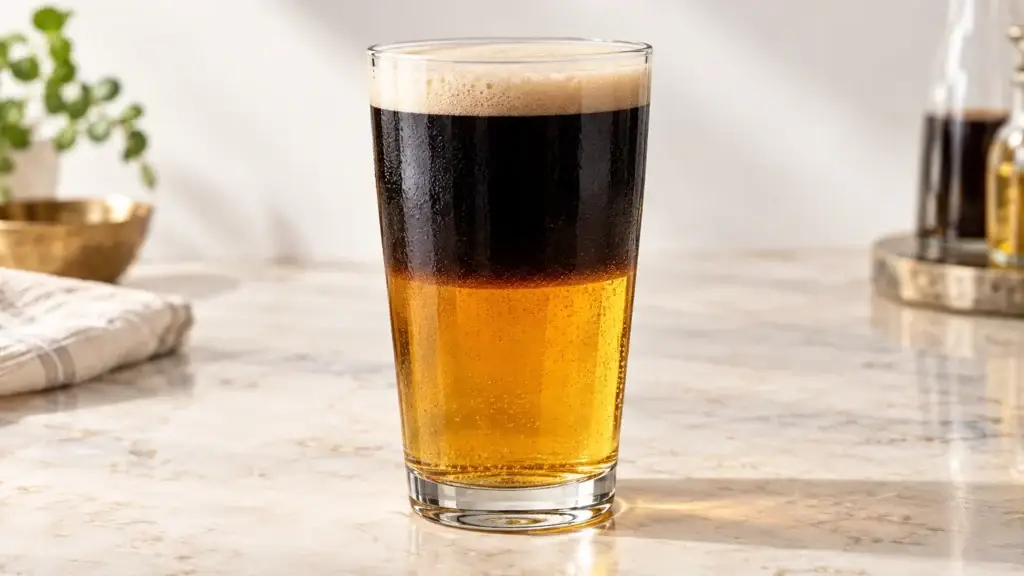
Black and Tan
Pale ale with stout floated on top, in two layers. A Victorian pub drink that looks like a magic trick and tastes…
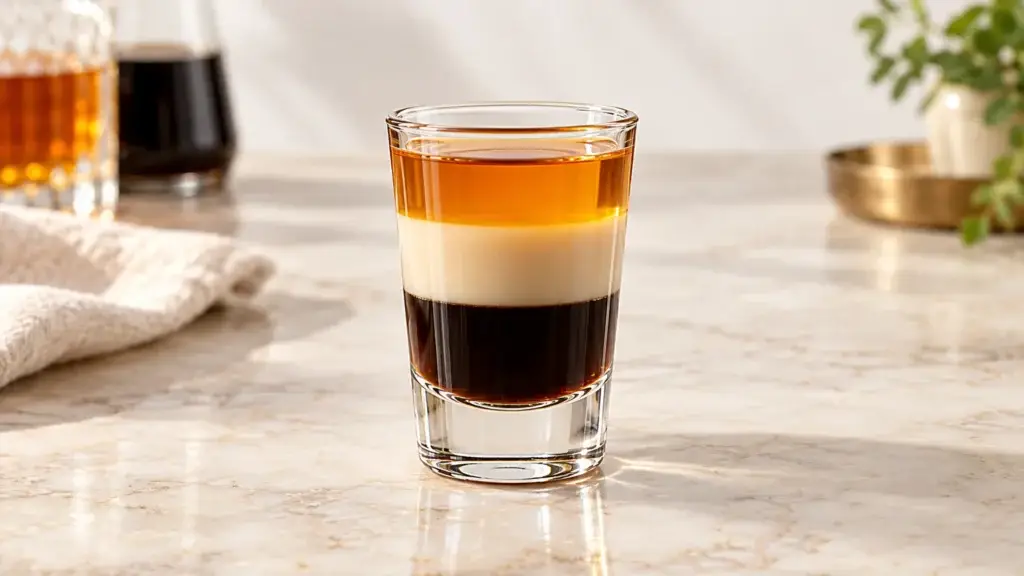
B-52
Coffee liqueur, Irish cream and orange liqueur, layered in a shot glass. The 1970s layered shot that is still the one everyone…
Buttery Nipple
Buttery Nipple is made with butterscotch schnapps layered with Irish cream in a sweet two-liqueur shot, served cold.