
Mixing Glass
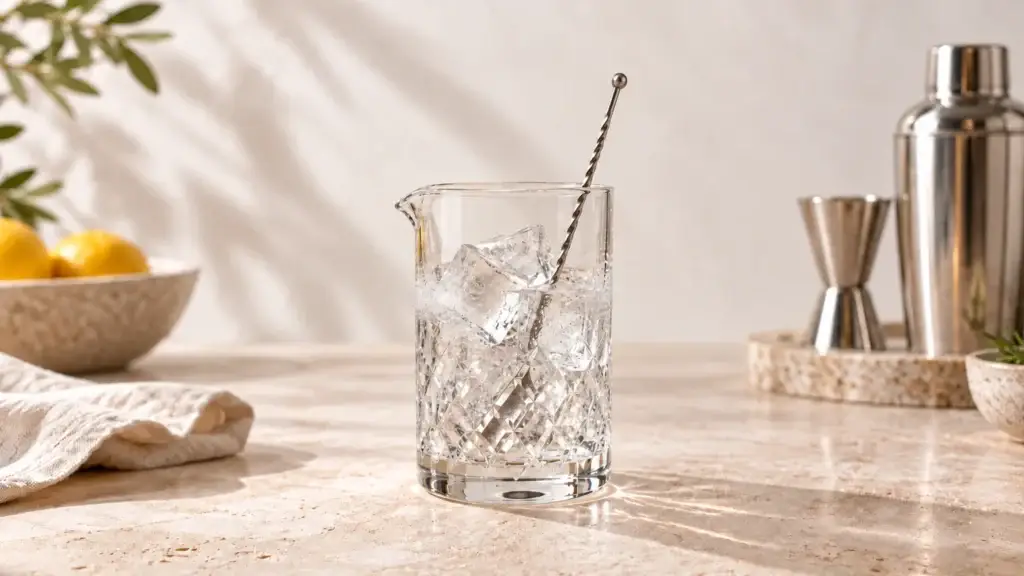 AI sample photography
A mixing glass is a bar tool that is almost entirely unnecessary and almost universally wanted. You can stir a Martini in a shaker tin and nobody will taste the difference. You will, however, be able to see what you are doing in a mixing glass, and that turns out to matter more than it sounds.
Our picks
Buy a heavy, wide, seamless mixing glass of roughly 500 to 750ml with a thick base and a spout. Weight is the useful property: a heavy glass stays put while you stir with one hand, and its thermal mass helps hold the cold.
Japanese-style cut-crystal mixing glasses are the ones usually photographed, and the cutting is decoration — it affects grip slightly and nothing else. A plain heavy glass performs identically.
A yarai-pattern glass at around 550ml suits a single or double stirred drink, which is what most people make. Larger glasses are for batching two or three at once and are harder to stir smoothly.
How to choose
Check the base first. Thick and flat is what you want; a thin base cracks against ice and a domed one makes the ice sit oddly. Weight the glass in your hand — it should feel substantial enough to resist a firm stir.
Check the spout, if it has one. A well-formed spout pours cleanly; a poorly moulded one dribbles down the outside, and you will notice every time.
Check the mouth width against your Hawthorne strainer or a julep strainer, since you will be straining out of it. A glass that is wider than your strainer is a glass you cannot strain from cleanly.
Seamless is better than moulded. A visible mould seam up the side is a weak point and an irritation under the fingers.
How to use it
Fill it two-thirds with good cubed ice, add the ingredients, and stir with a barspoon for about thirty seconds, until the outside frosts. Keep the back of the spoon’s bowl against the inner wall so the ice rotates as a mass rather than being chopped about. There is more in how to stir a cocktail.
The real advantage over a tin is simply that you can see it. You can watch the dilution, see the colour change as the drink comes together, and see the frost line climb the outside — all of which are better signals than counting. For a Manhattan, a Martini or a Negroni, that visibility is the whole case for owning one.
Chill it first if you can. A room-temperature glass costs you dilution you did not plan for; a minute of ice and water in it while you gather bottles is enough.
Use big, dry cubes. Wet ice straight from a melting bag has already started diluting and will carry that water into the drink — see ice and dilution.
What to skip
Skip it entirely if you are buying your first tools. The large tin of a Boston shaker stirs perfectly well, and the guide lists this as a second-wave purchase for exactly that reason — see bar tools you actually need.
Skip thin-walled glasses and anything described as lightweight; they lose temperature fast and chip against ice. Skip very large mixing glasses unless you batch, since a half-empty glass stirs badly.
Skip lidded mixing glasses and combination shaker-stirrers, which do neither job properly. And skip the idea that the cut pattern improves the drink — it improves the photograph.
Questions
Do I need a mixing glass? No. A shaker tin stirs just as well. You buy one to see what you are doing.
What size should I get? Around 550ml for one or two drinks. Larger only if you batch.
Does the cut pattern matter? Only for grip and looks. It makes no difference to the drink.
Can I use a pint glass? Yes, and people did for decades. It is lighter and chips more easily.
Should I chill it first? Yes. A warm glass costs you unplanned dilution.
Read the full bar tools guide — which seven tools to buy, in what order, and what to ignore.